 EN
EN

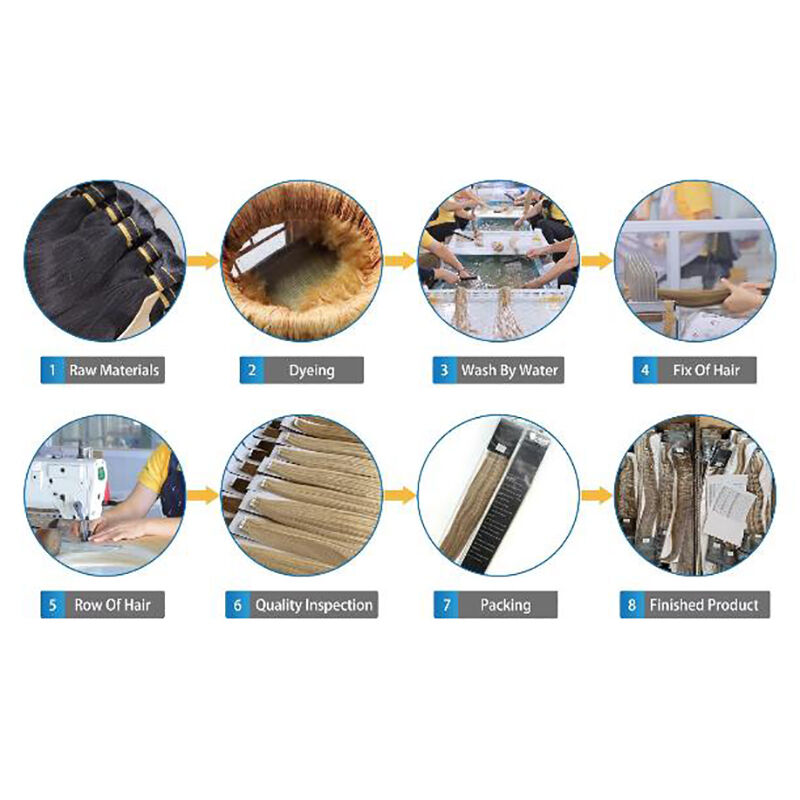
The processing of raw hair is a multi-stage industrial (and sometimes artisanal) process designed to clean, sanitize, sort, and align the hair so it behaves like a natural, healthy head of hair.
Here is a breakdown of how raw hair is processed, from harvest to the final product.
Sourcing and Sorting
The process begins with the raw material. Most high-quality human hair comes from countries like India, China, Brazil, and Russia, often from religious or cultural donations (like the Temple Hair from India, donated by pilgrims).
• Initial Sorting: Upon arrival at a processing facility, the hair is dumped out and sorted by length. It is often still tangled and may contain short hairs, knots, or debris.
• The Cuticle Direction: This is the most critical part of the process. High-quality "cuticle hair" (also called "cuticle intact") requires all the strands to face the same direction (root to tip). If strands are mixed (some root-up, some root-down), the hairs will rub against each other, causing severe tangling and matting for the wearer. Manufacturers ensure this alignment either by hand (for luxury hair) or by using machines that detect the root bulb or the taper of the tip.
Washing and Sanitization
Raw hair is dirty. It contains oils, dirt, bacteria, and often a strong natural odor.
• Chemical Baths: The hair is soaked in vats of detergent, antiseptic solutions, and degreasers.
• Sanitization: Strong antiseptics are used to kill bacteria and fungi. This step is crucial for safety, as raw hair can carry pathogens from its country of origin.
l Deodorizing: Specific chemicals are used to neutralize the natural "human" smell of the hair, leaving it neutral or lightly scented.
The "Remi" Process (Cuticle Alignment)
You often hear the term "Remy" (or "Remi") hair. This is not a brand; it is a grade of processing.
• What it is: Remy hair is hair where the cuticles (the tiny overlapping scales that cover the hair shaft) are all kept intact and facing the same direction.
• Why it matters: Because the cuticles act like barbs on a feather. If they are all facing down (toward the tips), they lie flat and smooth. If they are mixed, they interlock and cause tangles.
• Processing: To achieve this, workers or machines meticulously ensure the root ends are bundled together. This is the most labor-intensive part of processing and the main reason Remy hair costs significantly more than non-Remy hair.
Acid Bath (Cuticle Laying)
Even after aligning the hair, the cuticles naturally stand up or get roughed up during handling.
• The Process: The sorted hair is dipped into an acidic solution (often a mild citric or acetic acid).
• The Science: Hair has a natural pH of around 4.5 to 5.5. When hair is alkaline (high pH), the cuticle scales open. When it is acidic, the cuticle scales contract and lie flat. This acid bath seals the cuticles down against the shaft, making the hair instantly smoother, shinier, and less prone to tangling.
Chemical Stripping (Optional)
Not all hair goes through this step. If the hair is going to be sold in a color other than its natural black or dark brown, it must be stripped.
• Lightening: The hair is soaked in a hydrogen peroxide or bleach solution. Unlike bleaching hair on a scalp (which happens quickly), industrial bleaching of harvested hair is carefully timed to lift the natural melanin without destroying the integrity of the shaft.
• Result: The hair turns a reddish-orange, then a pale yellow or "platinum" blonde. This stripped hair acts as a canvas. It is then dyed with synthetic pigments to achieve consistent colors like honey blonde, ombre, or burgundy.
Silicon Coating (The "Slip")
Almost all commercially sold hair extensions undergo a silicon bath.
• The Process: The hair is dipped in a vat of silicone (often dimethicone or amodimethicone).
• The Purpose:
• Slip: It makes the hair incredibly slippery and easy to brush through.
• Shine: It fills in any microscopic gaps in the cuticle, creating a reflective, glossy surface.
• Protection: It creates a barrier that protects the hair from humidity and minor heat damage.
Note: Over time, this silicone coating washes off. This is why high-end extensions often look better after the first few washes (once the heavy industrial silicone is gone) than they did in the package, whereas low-quality extensions look dull and dry once the silicone is stripped away.
Drying and Steaming
After the chemical baths and coloring, the hair is wet and fragile.
• Industrial Drying: The hair is laid out in drying racks or spun in centrifuges to remove excess water.
• Heat Setting: The hair is passed through steam chambers or flat-iron machines. This not only dries the hair but also "sets" the texture. For curly or wavy hair, the hair is wrapped around rods (like perm rods) and steamed to lock in the curl pattern. For straight hair, it is pulled through heated ceramic plates to press the strands perfectly flat.
Final Sorting and Grading
Once the processing is complete, the hair undergoes a final quality control check.
• Length Sorting: The hair is run through machines that cut it to precise lengths (e.g., 14 inches, 20 inches). Manufacturers often have to account for "shrinkage" in curly textures.
• Weighing: The hair is weighed into precise bundles (usually 100g, 3.5oz, or 4oz).
• Grading: The hair is graded from 7A to 10A (or higher, though there is no universal standard). Higher grades indicate that the hair is 100% Remy, has a thick weft, minimal shedding, and a long lifespan (1+ years).
Summary Table: Processing Methods by Quality
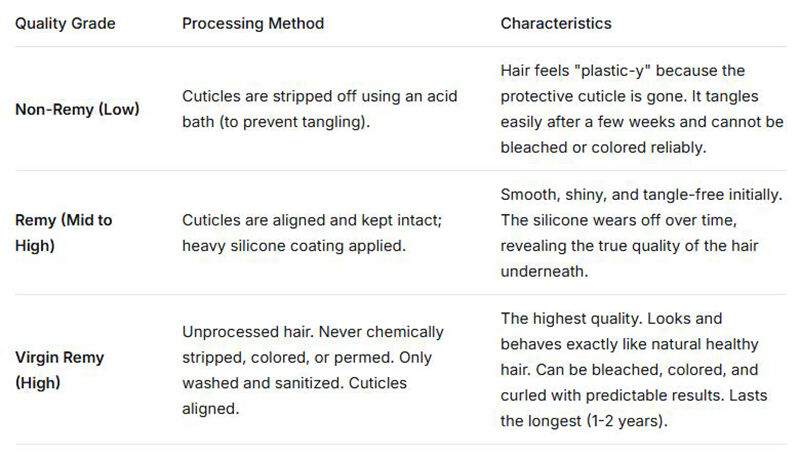
If you are considering buying extensions, the "Remy" processing step is the most important one to look for, as it determines whether the hair will last for months or become a tangled mess after a few washes.