 EN
EN

Testing for Virgin One Donor Hair is the most critical technical skill in the hair extension industry. This hair is premium because it is cut directly from a single donor, ensuring all cuticles are aligned (Virgin) and the hair remains free of chemical processing.
Below are the industry-standard testing methods, ranked from basic to expert level:
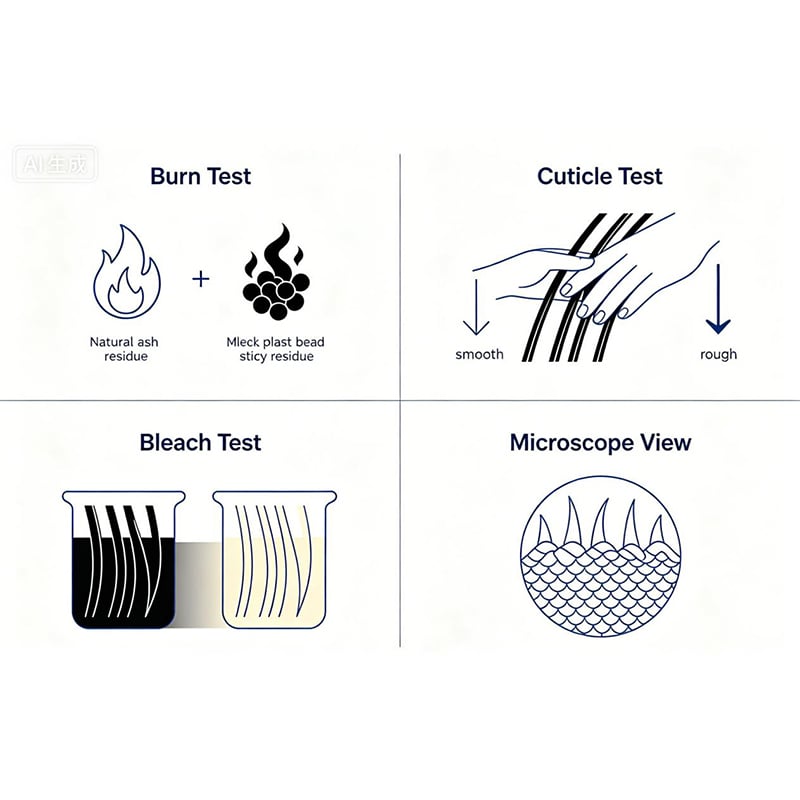
The Burn Test (Distinguishing Human Hair from Synthetic)
This is the fundamental first step to confirm the biological composition of the hair.
Procedure: Burn a few strands of hair with a lighter.
• Human Hair: It smells like burnt feathers or nails. It burns quickly and turns into fine black ash that crumbles easily between your fingers.
• Synthetic/Fiber: It smells like burnt plastic and produces black smoke. It melts into a hard, uncrushable black bead.
The Cuticle Test (Distinguishing Remy from Non-Remy)
The value of braid hair lies in its perfectly aligned cuticles.
Procedure: Hold a single strand and slide your fingers from root to end (downwards), then from end to root (upwards).
• Virgin Braid Hair: It feels smooth sliding downwards but offers noticeable resistance or a slight "squeak" when sliding upwards (against the scales).
• Non-Remy/Acid-washed: If it feels smooth in both directions, the cuticles have been acid-washed away. If it feels rough in both directions, the cuticles are tangled and misaligned.
The Bleach Test (The Gold Standard)
Procedure: Submerge a sample in high-strength bleach powder.
• Premium Braid Hair: It can be safely bleached to #613 (Pale Blonde) or even #60 (Platinum Blonde) while maintaining its elasticity, shine, and strength.
• Low Quality/Fallen Hair: It usually stops reacting at #27 (Ginger/Strawberry Blonde) or begins to melt, sizzle, and break. This indicates the hair was previously dyed or acid-treated.
The Wet & Wash Test (Detecting "Silicone Traps")
Many factories coat low-quality hair in thick silicone to fake a smooth texture.
Procedure: Wash the hair 3 to 5 times with a clarifying shampoo—do not use conditioner—and let it air dry.
• Authentic Braid Hair: It remains smooth, manageable, and shows its natural wave pattern with zero tangling.
• Silicone-coated Hair: Once the coating washes off, the hair reveals its true state, becoming dry, frizzy, and severely tangled (a "bird's nest").
Visual Inspection
• Roots: Authentic bulk braid hair should have milky-white protein residues (root sheaths) at the top, and all roots must point in the same direction.
• Color Consistency: A single donor's hair will have subtle, natural color variations. If a bundle is perfectly monochromatic from root to tip, it has likely been pre-dyed.
• Ends: Braid hair naturally has tapered ends. If the ends are unnaturally thick and blunt, verify if it was processed as Double Drawn (manually removing short hairs) or if it is a mix of different hair lengths.
Microscopic Analysis (400x)
Under a 400x microscope, the cuticles of authentic braid hair look like overlapping fish scales or roof tiles, all pointing in one direction. If the surface appears completely smooth or glass-like, the cuticles have been destroyed by chemicals.