 EN
EN

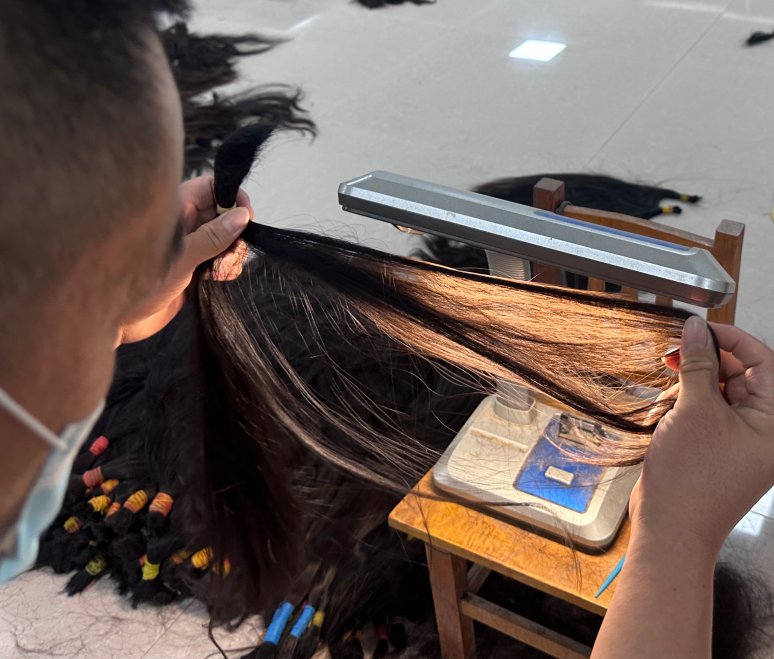
The quality of a finished hair extension is determined long before the hair becomes a weft, tape, keratin bond or nano-tip product. It begins with the raw material and how that material is collected, inspected, processed and sorted.
For its Top Line, Fasimei does not start with ready-made double-drawn hair purchased from the general market. Instead, we begin with carefully selected original donor ponytails and complete the bleaching, color classification and double-drawing stages under our own production control.
This approach requires more raw material, more manual sorting and more production time. However, it allows us to understand how each original bundle responds before hair with different characteristics is mixed together.
Fasimei uses original donor ponytails because different donors’ hair can respond differently to bleaching and coloring.
If hair from many donors is blended and double drawn before the factory receives it, the original characteristics of each bundle may already be impossible to identify. Some strands may lift faster, while others require more processing.
By keeping the original ponytails separate during the early processing stages, Fasimei can evaluate their condition and lifting response, allocate suitable bundles to different color directions and complete the final double-drawing process under controlled conditions.
What Is Fasimei Top Line Hair?Fasimei offers different hair lines for different markets and product requirements. The Top Line is intended for professional buyers who place greater importance on raw-material selection, cuticle condition, color performance and product consistency.
The Top Line starts with carefully selected Chinese single-donor ponytails. The hair is collected as an original cutting bundle, with the roots and ends kept in the same direction.
The selected raw material should have:
However, “single donor” does not automatically mean that every original ponytail meets the Top Line standard.
Hair naturally varies from one person to another. Differences may include strand shape, texture, porosity, natural base color, previous chemical treatment and response to bleaching.
Some original bundles may have a strand structure or texture that does not match the intended appearance of the Top Line. Other bundles may have been dyed or chemically treated before collection, making their processing history and future color response more difficult to control.
These bundles are separated during inspection rather than being mixed into the Top Line material.
Why Doesn’t Fasimei Buy Ready-Made Double-Drawn Hair?Ready-made double-drawn hair can make purchasing and production easier.
Hair traders may collect hair from multiple sources, clean it, sort it by length, remove shorter strands and prepare it into standard bundles. Factories can then purchase the prepared hair by length and weight.
The limitation is that hair from different donors may already have been mixed during cleaning, sorting and double-drawing.
Once the original bundles are mixed, the factory may no longer be able to identify the characteristics of each donor’s hair.
The blended batch may contain strands with different:
The prepared hair may look consistent before processing but respond differently during bleaching and coloring.
Why Can Mixed Donor Hair Cause Uneven Bleaching?Different donor bundles do not always lift at the same speed.
Some hair may reach the required lifting stage relatively quickly. Other hair may require more time to reach the same base.
When these strands are processed together, the faster-lifting hair may remain in the bleaching process while the slower-lifting hair catches up. This can expose part of the batch to more processing than necessary.
The result may include:
This issue becomes especially important when producing:
Differences that are difficult to see in natural dark hair can become more noticeable after the hair is lifted to a lighter base.
How Does Fasimei Process Original Donor Ponytails?Fasimei keeps selected original ponytails separate during the early processing stages.
Instead of blending all the hair first and bleaching it as one mixed batch, we observe how each original bundle responds during controlled lifting.
Bundles that lift more efficiently may be allocated to lighter colors. Hair that lifts more slowly but remains suitable for processing may be used for darker shades that require less chemical exposure.
This allows the natural characteristics of the raw material to influence its final color application.
The purpose is not to force every original bundle through exactly the same bleaching process. It is to match suitable raw material with an appropriate color direction.
This approach can help:
Only after bleaching, coloring and the relevant quality checks does Fasimei begin the final length sorting and double-drawing process.
Why Does Fasimei Double Draw the Hair After Color Processing?Double drawing is used to reduce the proportion of shorter strands and create fuller-looking ends.
When ready-made double-drawn hair is purchased from an outside source, much of the collection and sorting process has already taken place. The factory has less control over how the hair was handled before it arrived.
By completing double drawing after color processing, Fasimei can manage the selected hair within its own production process.
This provides greater control over:
This does not mean that double drawing alone determines hair quality. It is one part of a broader process involving raw-material selection, cuticle direction, chemical processing and final construction.
Why Does Hair Direction Matter?Human hair cuticles naturally overlap in one direction, from the root toward the ends.
When all strands remain aligned in their original direction, their surfaces generally move against each other with less opposing friction.
If loose or floor-collected hair is added without reliable directional control, some strands may be reversed. Opposing cuticle directions can create more friction between the hair shafts and increase the risk of tangling.
This is why Fasimei pays attention to directional alignment throughout raw-material handling and production.
However, no responsible manufacturer should promise that hair will never tangle.
Hair performance can also be affected by:
Maintaining cuticle direction helps reduce one avoidable source of friction, but it is not the only factor that affects performance.
Buyers can also learn more about how hair processing affects extension quality, particularly when comparing natural dark hair with blondes and dimensional shades.
How Does Fasimei Control Its Raw-Material Supply Chain?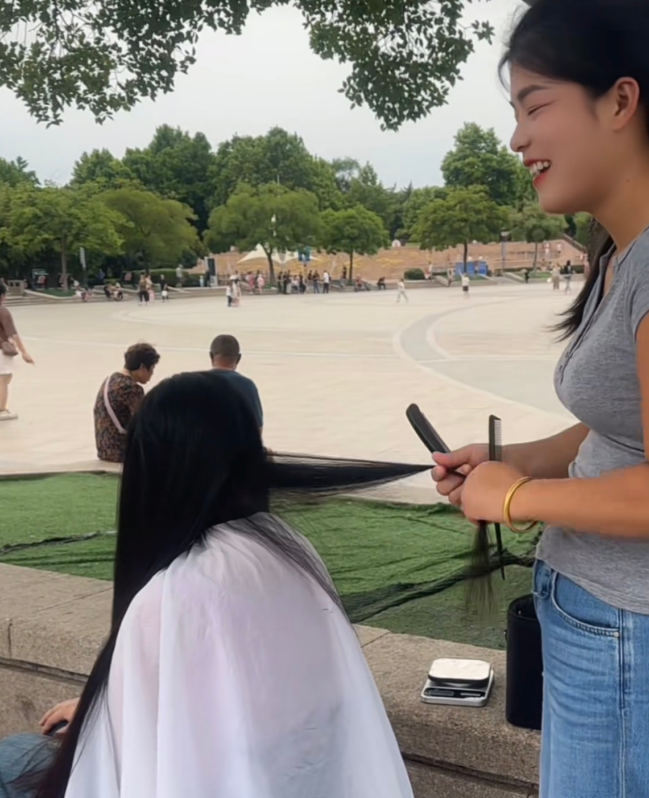
Fasimei works directly with established hair collectors who gather original ponytails through their local collection networks.
When a practical collection quantity is ready, the original bundles are sent to Fasimei for inspection.
The hair is not accepted automatically simply because it arrives as a donor ponytail. The quality-control team evaluates the bundles and separates material that does not meet the requirements of the intended product line.
The inspection may consider:
Hair that does not meet the Top Line specification is removed from the selected production material.
This inspection and rejection process is one reason the Top Line requires more raw material and a higher production cost than a product made from ready-prepared market hair.
Is All Single-Donor Hair Top Line Hair?No.
Single donor describes the original source structure of the ponytail. It does not automatically prove that the hair is healthy, uncolored, cuticle-aligned or suitable for blonde processing.
A single-donor ponytail may still contain:
The term should therefore be treated as one part of the raw-material description—not as a complete quality guarantee.
Professional buyers should ask:
The answers to these questions provide more useful information than the “single donor” label alone.
Is Ready-Made Double-Drawn Hair Always Poor Quality?No.
Ready-made double-drawn hair is not automatically poor quality. It may be suitable for product lines that prioritize efficient production, standard lengths and more accessible pricing.
The important issue is whether its source, direction, processing history and batch consistency match the requirements of the intended product.
Fasimei does not use ready-made double-drawn hair for its Top Line because this line requires more control before the hair is blended and length sorted.
Different product lines may use different raw-material and processing strategies. These differences should be clearly explained rather than hidden behind general terms such as “premium grade” or “best quality.”
Raw-material selection can affect more than the appearance of the first sample.
For wholesalers, salons and private-label brands, it may influence:
The same raw-material principles can apply across different extension formats. However, the construction must also be evaluated separately.
For products such as Genius Weft, buyers should evaluate both the condition of the hair and the construction of the weft.
Hair quality and product construction are related, but they are not the same question. Good raw material can still be affected by unsuitable processing or inconsistent construction.
What Should Buyers Check Before Approving a Sample?A buyer should not approve Top Line hair based only on its initial softness or shine.
The sample should be evaluated against a written specification that covers:
The buyer should then document the hair before and after controlled washing.
Professional buyers can follow this guide on how to test hair extension samples before placing a wholesale order.
A sample can show how one submitted product performs. It cannot, by itself, prove that every future bulk order will be identical.
The buyer should also confirm:
Buyers should also understand why sample quality can differ from bulk orders before moving from one approved sample to a larger purchase.
The Fasimei Top Line ApproachFasimei’s Top Line is built around greater control at the raw-material stage.
The process begins with selected original donor ponytails, followed by:
The purpose is not simply to use a more expensive raw material.
The purpose is to preserve information about the original hair for longer, allowing processing decisions to be made before hair with different characteristics is blended together.
For professional buyers, this creates a clearer basis for discussing:
No. Donor hair varies in natural color, porosity, strand structure, previous treatment and lifting response. Each original bundle should be evaluated before it is assigned to a blonde product.
No. “Double drawn” describes the distribution of hair lengths and the fullness of the ends. “Single donor” describes the original source of the hair.
Hair can be double drawn without being single donor.
This allows Fasimei to observe the response of the original bundles first, classify the hair and then control the final length distribution within its own production process.
No. Cuticle alignment helps reduce opposing friction, but processing, construction, installation, maintenance and customer care also affect tangling and overall performance.
The Top Line requires more selective raw material, rejection of unsuitable bundles, additional manual inspection, controlled color processing and in-house length sorting.
The cost reflects the raw-material selection and production work required to meet the defined specification.
Ready-made double-drawn hair can simplify purchasing and production, but the original donor characteristics may already have been mixed before the hair reaches the factory.
Fasimei chooses to start its Top Line with selected original donor ponytails so that the hair can be inspected, processed and classified before final double drawing.
For professional buyers, the important question is not only whether a supplier uses “single-donor hair.”
Buyers should also ask:
These questions provide a more useful basis for evaluating hair quality than a product label alone.
Looking for a professional hair extension line developed around controlled raw-material selection and color processing? Contact Fasimei Hair to discuss your target products, colors and sample specifications.