 EN
EN

How to Evaluate a Hair Extension Factory Before a Long-Term Partnership
Choosing a hair extension factory is not only a price comparison. For wholesalers, professional salons and private-label brands, the larger risk is whether the supplier can understand a specification, reproduce an approved sample, manage color and construction differences and communicate clearly when production changes occur.
A reliable evaluation therefore needs more than a factory video, a soft sample or a list of product claims. Buyers should examine the match between the factory’s capabilities and their own product requirements, then verify that match through samples, documents, trial orders and repeat-order performance.
Define What You Need the Factory to Do
Start with your business model. A salon buying a focused color range has different requirements from a distributor managing multiple methods, or a private-label brand developing custom construction and packaging.
Prepare a short sourcing brief covering product methods, target client hair type, quality level, color range, lengths, weights, packaging, expected order pattern and development requirements. The goal is not to find the factory with the longest product list. It is to find a manufacturer whose real capabilities fit the products that matter to your business.
Evaluate Product Knowledge Through Specific Questions
Generic answers such as “best quality,” “no tangling” or “European hair” do not explain how a product is made or controlled. Ask questions that require a specific answer:
- How is this hair category defined?
- Which processing steps are used for dark and light shades?
- What construction options are available for this product?
- Which dimensions and tolerances can be written into the specification?
- What differences should a buyer expect between colors or lengths?
- Which professional installation methods are compatible with the product?
- What information must be reconfirmed for repeat orders?
A strong supplier should be able to explain product limitations as well as benefits. Absolute promises are less useful than clear conditions, specifications and testable expectations.
Test Sample Quality and Sample to Bulk Repeatability
The first sample should be evaluated against a written specification and a repeatable test method. Check weight, length, color, ends, construction and behavior after controlled washing. For detailed steps, use the related guide, “How to Test Hair Extension Samples Before Placing a Wholesale Order.”
After approving the sample, ask how it will be referenced during production. Confirm tolerances, custom-color references, inspection points and the process for handling differences. When commercial risk is meaningful, use a small trial order or pre-production confirmation before placing a large order.
Examine the Quality Control Process
Do not accept “strict quality control” as a complete answer. Ask what is checked, when it is checked, who records the result and which standard is used for approval.
Relevant checkpoints may include raw-material sorting, color confirmation, in-process construction checks, weight and length verification, finished-product appearance and final packing review. The exact process will vary by product. What matters is whether the factory can connect each checkpoint to your approved specification.
Check Manufacturing and Development Fit
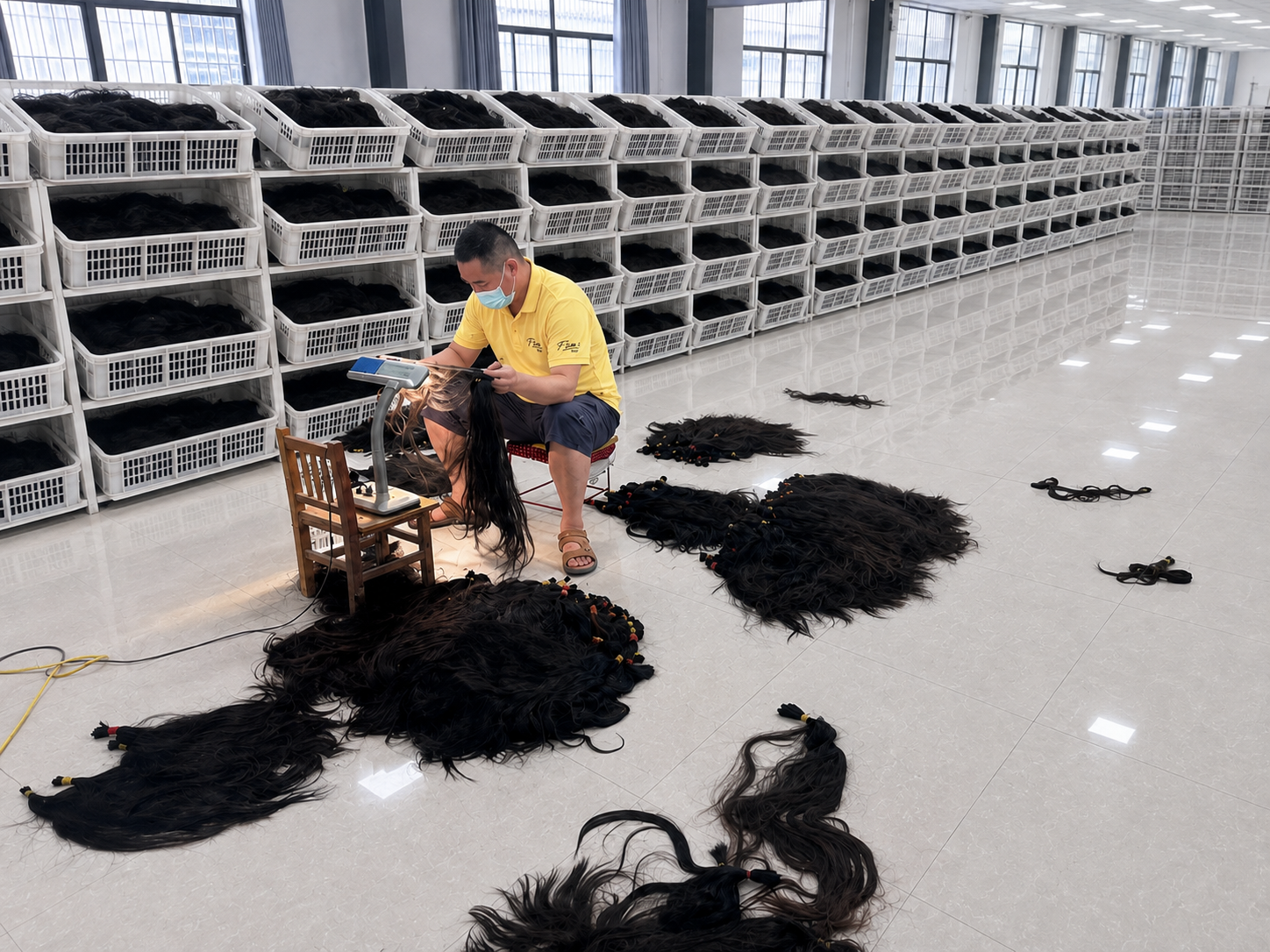
Factory size by itself does not prove quality. Evaluate whether the supplier has the people, equipment, product experience and capacity needed for your order pattern. A buyer developing Genius Weft, Tape-In, Keratin, Nano or a new weft structure should ask for relevant examples and a clear development process.
For custom development, confirm who receives the brief, how prototypes are reviewed, how revisions are recorded, who approves the final standard and how that standard moves into repeat production. Product development should leave a usable specification, not only a sequence of chat messages.
Compare Price Against the Same Specification
A meaningful price comparison requires equivalent products. If two quotations use different hair categories, weights, lengths, drawn levels, colors, attachments, packaging or tolerances, the lower quotation may simply describe a different product.
Ask for a quotation that separates the product specification, packaging, customization and logistics where practical. Confirm what may change when raw-material costs, exchange rates or order quantities change. Price transparency is the ability to explain what the quotation includes, not a promise that prices will never move.
Review Communication and Problem Handling
Communication quality becomes especially important when specifications are detailed or problems occur. During sampling, note whether the supplier asks clarifying questions, records revisions accurately and identifies conflicting requirements.
Before committing to a long-term partnership, discuss how quality concerns are documented, what evidence is required, who makes the decision and which remedies may apply. Do not wait for a serious complaint to discover that both sides have different expectations.
Verify Export Documentation and Logistics Responsibilities
Confirm the legal company name on quotations and commercial documents, the expected export documentation, shipping terms and the party responsible for each step. Ask whether the supplier has experience shipping the relevant products to your market, but do not treat past shipments as a guarantee of future customs outcomes.
Incoterms, customs clearance, duties, restricted materials and local importer responsibilities should be confirmed for each destination and shipping arrangement.
Use a Factory Evaluation Checklist
|
Evaluation area |
Evidence to request |
Decision question |
|
Product fit |
Relevant samples and specifications |
Can the factory make the products that matter to us? |
|
Quality definition |
Written terms, tolerances and references |
Do both sides define quality in the same way? |
|
Sample performance |
Controlled test records |
Does the sample meet the agreed requirement? |
|
Repeatability |
Approval and bulk-control process |
Can the approved result be repeated? |
|
QC |
Checkpoints and records |
Is quality checked against a standard? |
|
Development |
Brief, prototype and revision process |
Can custom work be managed systematically? |
|
Commercial clarity |
Comparable quotation and terms |
Do we understand what the price includes? |
|
Communication |
Accurate written follow-up |
Can details and problems be handled clearly? |
|
Export readiness |
Company and shipping documents |
Are responsibilities and documents clear? |
How Fasimei Works With Professional Buyers
Fasimei Hair works with wholesalers, professional salons and private-label brands across products including Genius Weft, Tape-In, Keratin, I-Tip, Nano Ring and other extension formats. Discussions can include product specifications, color requirements, packaging, sample development and OEM or ODM needs.
The most productive starting point is a clear brief: target market, product method, quality expectation, color range, intended client, current problem and expected order model. This allows the sample and development process to focus on the buyer’s real business requirements.
Frequently Asked Questions
Is a large hair extension factory always more reliable?
No. Size and capacity matter only when they match the buyer’s order requirements. Product knowledge, specifications, quality control, repeatability and communication must be evaluated separately.
How can I verify quality before visiting the factory?
Start with written specifications, video calls focused on relevant processes, physical samples, controlled testing and a small trial order. A visit can add useful evidence but should not replace product evaluation.
Should I choose the supplier with the lowest price?
Only compare prices after confirming that the specifications are equivalent. Differences in weight, color processing, construction, packaging and tolerance can make apparently similar quotations fundamentally different.
What should be approved before bulk production?
Approve the written product specification, physical or color reference where applicable, packaging, quantity, tolerance, inspection expectations, lead-time terms and the process for handling nonconformity.
Conclusion
A long-term manufacturing partner should be evaluated through evidence: clear specifications, relevant samples, controlled testing, quality checkpoints, development discipline and accurate communication. No single claim, certificate, factory photograph or first sample can prove all of these factors on its own.
If you are evaluating a new hair extension product or supplier, begin with a written brief and a structured sample plan. Contact Fasimei Hair to discuss your target product, specifications and private-label requirements.
Transparent & Competitive Wholesale Pricing
Competitive pricing does not mean low-quality products. It refers to high cost performance based on stable quality.
Powerful hair extension factories have stable bulk raw material sourcing channels and automated production. They effectively reduce material waste and labor costs, so they can offer reasonable, transparent and competitive wholesale prices for global buyers.
Formal suppliers provide clear tiered pricing for small trial orders and large bulk orders, with no hidden fees or random price increases.
Strong R&D & Customization Ability
Top hair extension factories keep up with global market trends and launch new styles regularly, including popular wave textures, balayage, ombre and trendy color combinations.
They support flexible customization: custom length, density, color matching, private labels and customized packaging. Strong customization capability helps you offer differentiated products and stand out in the competitive hair market.
Complete Export Qualification & Overseas Experience
A qualified cross-border hair supplier must have complete export documents, standard customs clearance procedures and mature logistics resources.
Experienced factories are familiar with the import rules and tariff standards of the USA, Europe and South America. They ensure smooth customs clearance, stable lead times and professional after-sales support for international orders, avoiding delivery delays and compliance problems.
Good Reputation & Stable Long-Term Clients
A factory’s real strength can be proven by its customer base and feedback. Reliable hair extension manufacturers serve large numbers of repeated buyers, including global wholesalers, beauty salons and cross-border store owners.
High repeat order rates directly reflect stable quality, competitive prices and trustworthy service. Factories with mostly one-time customers usually have unstable quality or poor pricing advantages.
Final Words
Choosing the right hair extension factory is the foundation of a successful hair business. By checking production scale, quality control system, pricing transparency, R&D capability, export experience and customer reputation, you can easily filter high-quality suppliers. A professional hair extension factory always balances competitive wholesale pricing and consistent product quality, helping global buyers lower costs and achieve steady business growth.
Table of Contents
- How to Evaluate a Hair Extension Factory Before a Long-Term Partnership
- Define What You Need the Factory to Do
- Evaluate Product Knowledge Through Specific Questions
- Test Sample Quality and Sample to Bulk Repeatability
- Examine the Quality Control Process
- Check Manufacturing and Development Fit
- Compare Price Against the Same Specification
- Review Communication and Problem Handling
- Verify Export Documentation and Logistics Responsibilities
- Use a Factory Evaluation Checklist
- How Fasimei Works With Professional Buyers
- Frequently Asked Questions
- Conclusion
- Transparent & Competitive Wholesale Pricing
- Strong R&D & Customization Ability
- Complete Export Qualification & Overseas Experience
- Good Reputation & Stable Long-Term Clients
- Final Words