EN
EN

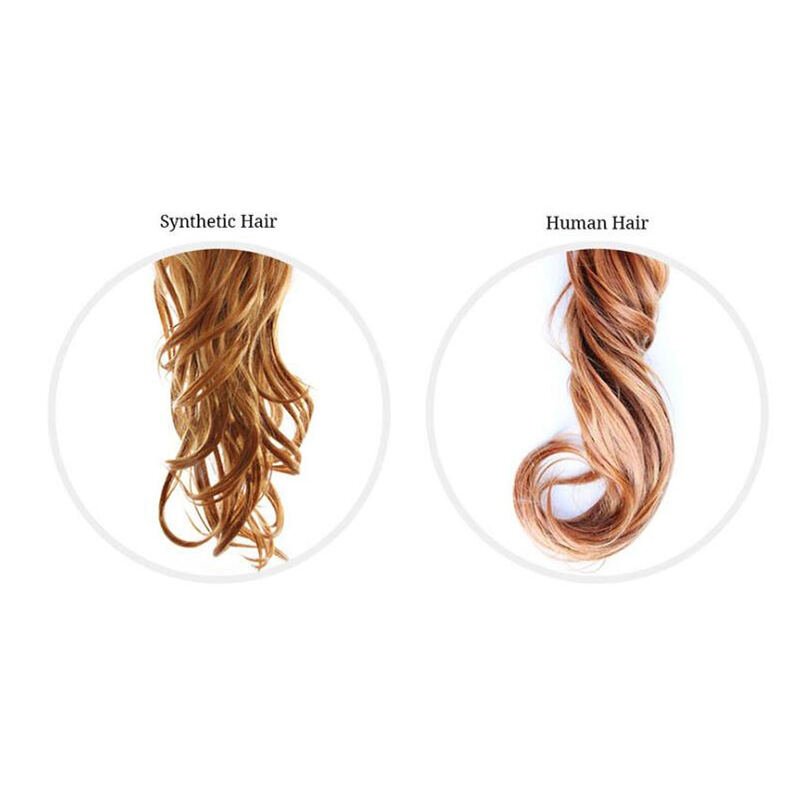
Distinguishing real human hair from synthetic hair (or blends) is important when purchasing wigs, extensions, or hairpieces. Here’s a comprehensive guide:
Visual Inspection
· Cuticle Alignment: Human hair has a natural cuticle that lies in the same direction from root to tip (like shingles on a roof). Under a magnifying glass, you may see tiny, overlapping scales. Synthetic fibers often have a perfectly smooth or inconsistently textured surface.
· Roots & Ends: Real hair roots may have follicles (tiny bulbs), and ends are naturally tapered. Synthetic hair often has blunt, melted-sealed ends and uniform roots.
· Color Variation: Natural hair has subtle color variations and highlights, even in solid shades. Synthetic hair can look unnaturally uniform or overly shiny.
Touch & Texture
· Feel: Human hair feels soft, smooth, and can get slightly oily over time. High-quality synthetic hair can feel soft too, but cheaper versions may feel coarse, plasticky, or unnaturally slippery.
· Elasticity: Gently stretch a few strands. Human hair has some elasticity and may stretch slightly before returning. Synthetic hair either doesn’t stretch much or stretches excessively and may not bounce back.
· Heat Test (Careful!): Use a flat iron on low heat on a single strand (do this discreetly if testing before purchase). Human hair will singe or curl with a burnt protein smell (like burning feathers/nails). Synthetic hair will melt, curl severely, or give off a plastic/chemical smell. Do not inhale fumes.
Burn Test (Most Reliable, but Destructive) Only do this on a small, hidden sample strand (e.g., from the weft of a wig or a few hairs from a bundle):
· Human Hair: Burns slowly, shrinks away from flame, smells like burning human hair or keratin (similar to burnt feathers or barbecue). Ash turns into fine, powdery gray residue.
· Synthetic Hair (plastic fibers like acrylic, PVC, kanekalon): · Burns quickly and melts, forming hard, dark beads at the tip. · Smells like burning plastic, chemicals, or petroleum. · May continue melting/dripping.
Water & Porosity Test
· Water Absorption: Human hair absorbs water and feels heavier when wet. It may also change texture (e.g., curly hair gets frizzier). Most synthetic hair repels water, dries quickly, and doesn’t absorb moisture.
· Float Test: Drop a strand in water. Human hair often sinks slowly due to porosity. Synthetic hair may float.
Styling & Heat
· Heat Styling: Human hair can be styled with heat tools (curling irons, straighteners) and will hold the style. Synthetic hair may melt or deform with high heat (unless it’s heat-resistant synthetic, which has limitations).
· Color Change: Human hair can be dyed or bleached (though processed hair may react differently). Synthetic hair cannot be lightened with hair dye—color may only coat the surface unevenly.
Price & Source
· Cost: Real human hair is significantly more expensive than synthetic hair. Extremely cheap “human hair” is often synthetic or heavily blended.
· Labeling: Check product descriptions. Terms like “100% Human Hair,” “Virgin Hair” (unprocessed), “Remy Hair” (cuticles intact and aligned) indicate real hair. “Synthetic,” “Kanekalon,” “Toyokalon,” or “Heat-Friendly Fibers” indicate synthetic.
Long-Term Behavior
· Over Time: Human hair may become dry, frizzy, or tangled with wear, much like natural hair, and may need conditioning. Synthetic hair often retains its style but can become frizzy, shiny, or tangled faster if low quality.